Devolution Watch follows the transfer of power and money to England’s regions as it is built, and reads each step for what it means for places and for planning. Its first piece, “Wired for growth”, read the Budget’s Fiscal Devolution Roadmap.
In my reading, English devolution is being built in three layers. The first is the legal framework, set by the English Devolution and Community Empowerment Act, which became law on 29 April 2026.1 The second is the fiscal arrangements, which are taking clear shape in the Roadmap published with the Budget on 28 October.2 The third is the conditions that decide who benefits from growth. Those are still to be written.
The framework comes first because it decides who holds power. The money follows. The fullest fiscal offer, including a share of income tax, is reserved for areas with a mayor.3 The tier a place reaches therefore decides what it can do and what it can receive.
This is the first of three parts, one for each layer. Parts 2 and 3, on the money and the conditions, follow. After that, the series will publish when a signal arrives, and when signals fall quiet.
What the Act sets up
The Act creates a single category of “strategic authority”, in three tiers.4 A foundation strategic authority is a county or unitary council designated as such, or a combined authority without a mayor. A mayoral strategic authority is a combined authority with an elected mayor, or the Greater London Authority. An established mayoral strategic authority is a mayoral authority designated by the Secretary of State on its own application, and the Greater London Authority is established by definition.5
Strategic authorities act within nine “areas of competence”: transport and local infrastructure; skills and employment support; housing and strategic planning; economic development and regeneration; the environment and climate change; health, well-being and public service reform; public safety; culture; and rural affairs and coastal communities.
The definitions and areas of competence have been in force since Royal Assent. The provisions for designating foundation and established authorities followed on 29 June 2026.6
The tiers matter because powers and money attach to them. Part 2 will show how far the fiscal offer depends on reaching mayoral status.
The government’s stated ambition is for everywhere in England to be covered by a strategic authority by the end of 2028.3 Local government reorganisation now has a vesting day of April 2029 for 20 areas.7 Read together, the two timetables mean that many new strategic authorities will be built on councils that are themselves being reorganised. That is the ground on which the framework is being laid.
The powers it gives mayors
Planning and land are prominent in the Act. Mayors gain powers over planning applications of potential strategic importance, mayoral development orders and a mayoral Community Infrastructure Levy. Strategic authorities gain powers to acquire and develop land, and mayors can establish mayoral development corporations. Regulations are to require spatial development strategies to address the desirability of prioritising previously developed land.8
These provisions are at different stages. The land and development corporation powers came into force at Royal Assent. The strategic planning powers, development orders and mayoral CIL wait on commencement regulations. At the time of writing, two sets of commencement regulations have been made, and neither brings these powers into force.9 The brownfield priority takes effect through regulations still to be made. In my reading, the powers that bear most directly on planning are the ones still waiting.
Local Growth Plans have been in force since 29 June 2026. Each mayoral authority must prepare and publish one, setting out the economic conditions of its area, its key projects, and priorities “agreed with the Secretary of State”.10 Public bodies named in regulations must have regard to those shared priorities when bidding for public funding or preparing statutory plans. Approving the plan is reserved to the mayor and cannot be delegated to a commissioner. In my reading, the Local Growth Plan is where central and local priorities formally meet.
Two quieter provisions matter for what follows in this series. A mayoral authority may pay grant to its constituent councils “on such conditions as the person paying it may determine”, a power exercised by the mayor and in force since Royal Assent.11 Combined authorities and the Greater London Authority must also co-operate with local government pension funds to identify investment opportunities, a duty in force since 15 July 2026.12 Part 3 of this series returns to both provisions.
Accountability
The Act builds accountability in several directions.
The Secretary of State must report to Parliament each year, as soon as practicable after 31 March, on devolution across England. The report must cover where strategic authorities have been established and the additional financial resources devolved to them.13 The first report after the Roadmap, due in spring 2027, will be a fixed point for this series.
Mayors of established authorities may ask the Secretary of State for changes to the law or to their funding. The Secretary of State must decide, and give reasons, within six months.14 This gives mayors a statutory route to press on the fiscal model before the Spending Review settles it.
Each mayoral authority is to have a “local scrutiny committee”. Its chair must be independent, or a councillor who is not a member of the mayor’s party, and regulations may give it power to impose penalties of up to £5,000.15 This regime is not yet in force.
Councils must make arrangements for the effective governance of neighbourhood areas, a duty in force since 29 June 2026. What counts as a neighbourhood area, and what arrangements are required, are both left to regulations not yet made. The government gathered evidence for a review of neighbourhood governance in autumn 2025, and has not yet published its outcome.16 The community right to buy assets of community value also awaits commencement.17
In my reading, the routes upwards to Parliament and Whitehall are in force. The routes to communities, through scrutiny and neighbourhoods, wait on commencement or regulations. Whether accountability comes to run to communities as well as to Whitehall is the framework’s open question.
What comes next
The framework is largely in place. Its planning powers and its routes to communities are still to come. For the framework, the series will watch for:
- commencement of the strategic planning powers and mayoral CIL;
- commencement of the local scrutiny committees;
- regulations for neighbourhood governance and the community right to buy;
- the first annual devolution report after 31 March 2027;
- requests from mayors for changes to law or funding.
Part 2 in this series will explore the emerging fiscal arrangements: what the Roadmap sets out, and what it leaves to the Spending Review. Part 3 will focus on the conditions attached to growth: whether the machinery for civic obligation, some of it already in this Act, will be used.
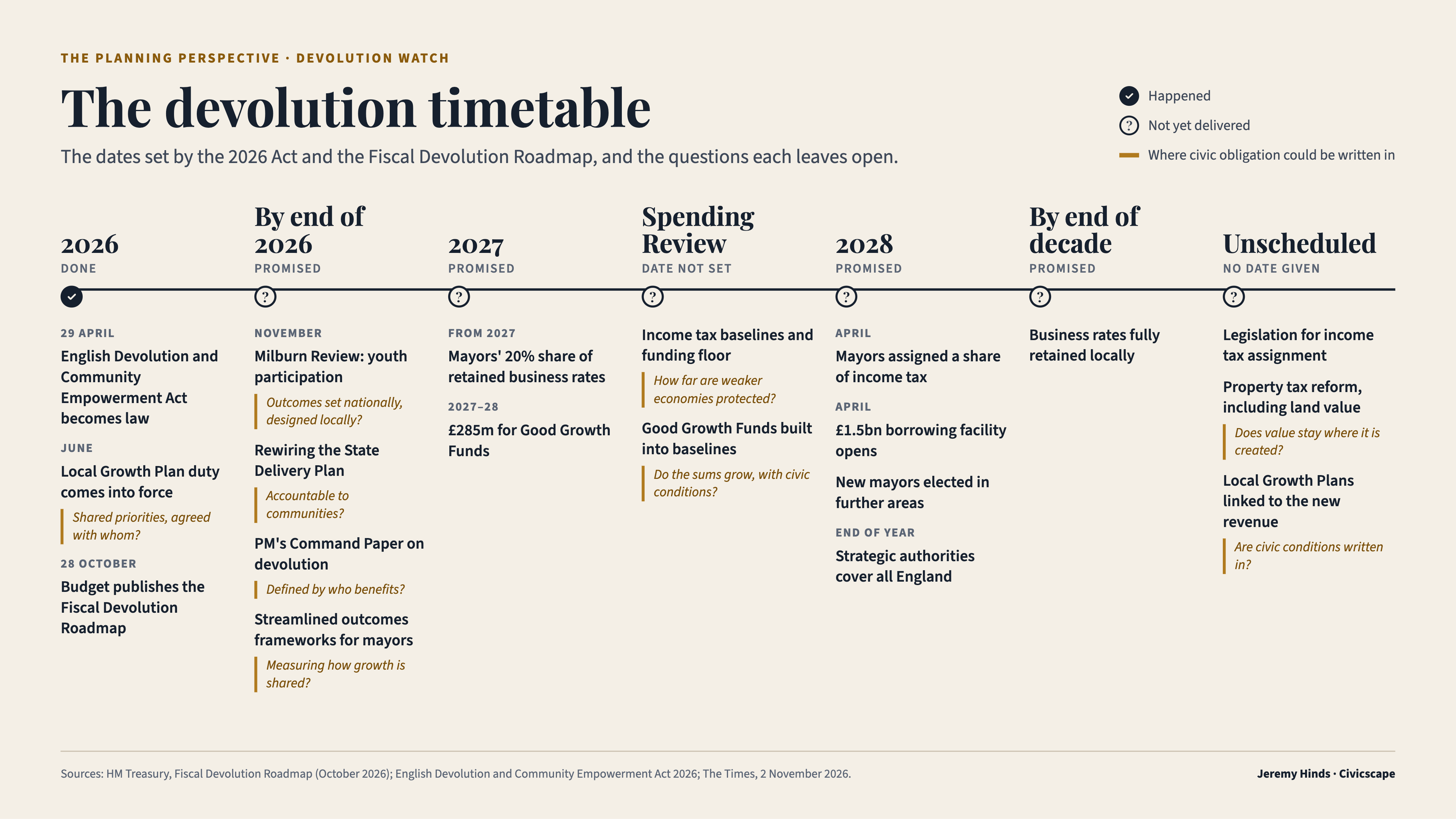
The devolution timetable sets out the dates across all three layers.
What should follow
Planners and local leaders should watch for commencement of the strategic planning powers, and help shape the regulations that will decide how far accountability reaches communities while they are still being drafted.
Notes
-
English Devolution and Community Empowerment Act 2026 (c. 23), Royal Assent 29 April 2026. https://www.legislation.gov.uk/ukpga/2026/23/contents ↩︎
-
HM Treasury, The Fiscal Devolution Roadmap: Reforming the Funding Model for Regional and Local Government in England, October 2026. https://assets.publishing.service.gov.uk/media/6ae103627b7111c482d80a99/Fiscal_Devolution_Roadmap.pdf ↩︎
-
HM Treasury, Fiscal Devolution Roadmap, paragraphs 2.10, 2.53 and 2.54. ↩︎↩︎
-
English Devolution and Community Empowerment Act 2026, sections 1 and 2. ↩︎
-
Ibid., sections 1(6) and 8. ↩︎
-
Ibid., section 108(1) and (5). ↩︎
-
Dan Peters, “April 2029 vesting day for all areas as ministers recommit to reorganisation”, The MJ, 29 October 2026. ↩︎
-
English Devolution and Community Empowerment Act 2026, sections 33 to 39 and Schedules 14 to 18 and 20. ↩︎
-
The English Devolution and Community Empowerment Act 2026 (Commencement No. 1 and Saving) Regulations 2026 (SI 2026/656); (Commencement No. 2) Regulations 2026 (SI 2026/812). Commencement information on legislation.gov.uk, consulted 4 November 2026. ↩︎
-
English Devolution and Community Empowerment Act 2026, section 41 and Schedule 22. ↩︎
-
Ibid., section 42, inserting section 32A into the Local Government Act 2003. ↩︎
-
Ibid., section 43; SI 2026/812, regulation 2(1)(a). ↩︎
-
Ibid., section 20. ↩︎
-
Ibid., section 53. ↩︎
-
Ibid., section 11 and Schedules 4 and 5. ↩︎
-
Ministry of Housing, Communities and Local Government, Neighbourhood Governance review, engagement survey, 16 September to 7 October 2025. https://consult.communities.gov.uk/local-government-reform-and-strategy/34514a08 ↩︎
-
English Devolution and Community Empowerment Act 2026, sections 62 and 67. ↩︎
Key concepts
- Strategic authority
- The Act’s single category for regional bodies, in foundation, mayoral and established mayoral tiers.
- Local Growth Plan
- A mayoral authority’s statutory plan for growth, with priorities agreed with the Secretary of State.
- Commencement
- The point at which a provision of an Act comes into force, often set later by regulations.
About the author
Jeremy Hinds is a chartered town planner (MRTPI) with over twenty-five years of experience in planning policy, housing delivery, development viability, and land acquisition.
Related pieces
Join the conversation about this piece on LinkedIn.